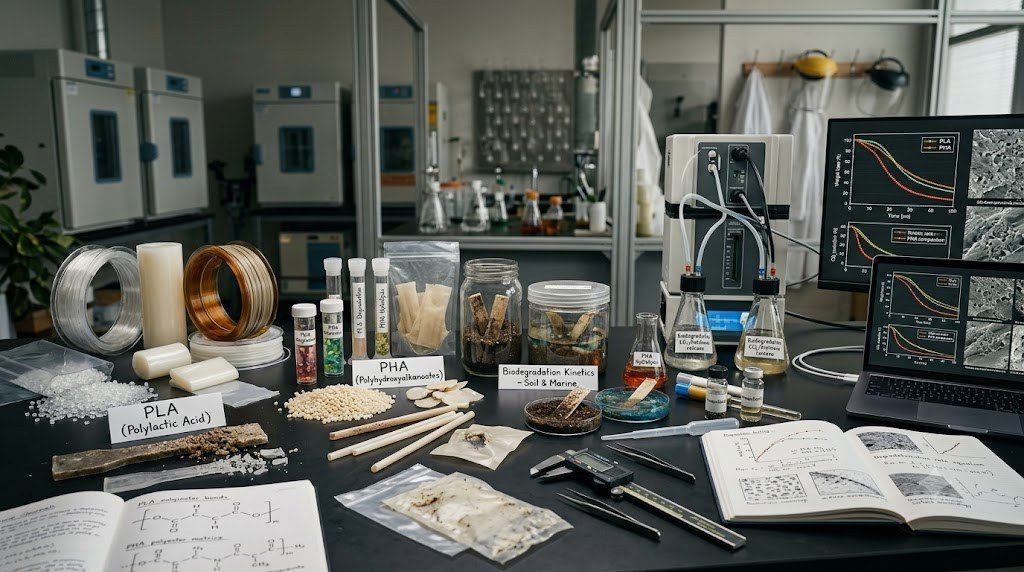
The accumulation of non-degradable petroleum-based plastics in marine ecosystems and terrestrial landfills has precipitated one of the most pressing environmental challenges of the modern industrial era. Traditional polyolefins (such as polyethylene and polypropylene) possess chemically stable, non-polar carbon-carbon backbones that resist natural enzymatic and microbial digestion, persisting in the environment for centuries. In response, global materials scientists and polymer chemical engineers have developed Bio-based and Biodegradable Polymers capable of returning harmlessly to natural biogeochemical cycles.
This comprehensive technical treatise investigates the molecular architecture, biosynthetic pathways, and environmental degradation kinetics of leading bioplastics. It focuses on Polylactic Acid (PLA), Polyhydroxyalkanoates (PHAs), and Polybutylene Succinate (PBS), evaluates abiotic hydrolysis versus microbial enzymatic cleavage, analyzes industrial composting versus marine biodegradation mechanisms, examines mechanical and thermal property enhancement via nucleating agents and plasticizers, and details international compostability certification standards.
1. Defining Bioplastics: Bio-Based vs. Biodegradable Matrix
In materials engineering, the term “bioplastic” is frequently misunderstood due to conflation between a polymer’s raw material origin and its end-of-life environmental fate. The international polymer classification matrix categorizes materials into four distinct quadrants:
1.1 The Four-Quadrant Polymer Classification Framework
- Bio-Based and Biodegradable (e.g., PLA, PHA, Starch Blends): Synthesized from renewable agricultural feedstocks (corn, sugarcane, microbial fermentation) and fully degradable into water, carbon dioxide, and biomass by biological microorganisms under defined environmental conditions.
- Bio-Based but Non-Biodegradable (e.g., Bio-PE, Bio-PET): Synthesized chemically from renewable bio-ethanol (from sugarcane fermentation) into identical ethylene monomers. While renewable in origin, their resulting macromolecular structures are chemically identical to fossil-derived polymers, possessing zero environmental biodegradability.
- Fossil-Based but Biodegradable (e.g., PBAT, PCL, PGA): Synthesized from petrochemical crude feedstocks, yet engineered with hydrolytically susceptible ester bonds along their main chain that enable rapid enzymatic digestion in soils and industrial composting facilities.
- Fossil-Based and Non-Biodegradable (e.g., Conventional PE, PP, PS, PVC): Traditional commodity petrochemical polymers that persist indefinitely in nature.
2. Polylactic Acid (PLA): Ring-Opening Polymerization and Stereochemistry
Polylactic Acid (PLA) is the commercially dominant aliphatic polyester produced from annually renewable resources. Its synthesis begins with the wet milling of corn starch or sugarcane, followed by bacterial fermentation (utilizing Lactobacillus bacterial strains) to convert glucose into lactic acid (2-hydroxypropanoic acid). Because lactic acid contains a chiral carbon center, it exists as two enantiomers: L-lactic acid and D-lactic acid.
Ring-Opening Polymerization (ROP) via Lactide Intermediates
Direct polycondensation of lactic acid is equilibrium-limited by the difficulty of continuously removing byproduct water from high-viscosity melts, typically yielding only low-molecular-weight oligomers ((M_w < 30,000 \text{ g/mol})). Modern commercial production (pioneered by NatureWorks LLC) utilizes Ring-Opening Polymerization (ROP):
- Lactic acid is oligomerized and catalytically depolymerized via a back-biting reaction into a cyclic dimer intermediate: lactide (3,6-dimethyl-1,4-dioxane-2,5-dione).
- Depending on the stereochemistry of the reacting lactic acid units, three lactide diastereomers form: L-lactide (two L-units), D-lactide (two D-units), and meso-lactide (one L- and one D-unit).
- High-vacuum distillation purifies the lactide isomers. Pure L-lactide undergoes coordination-insertion ring-opening polymerization catalyzed by tin(II) 2-ethylhexanoate (stannous octoate, (\text{Sn(Oct)}_2)) in the presence of alcohol initiators, synthesizing high-molecular-weight Poly(L-lactic acid) (PLLA) with (M_w > 150,000–300,000 \text{ g/mol}).
Stereocomplexation and Thermal Enhancement
Commercial PLLA is a semicrystalline polyester with a Glass Transition Temperature of (T_g \approx 55^\circ\text{C}–60^\circ\text{C}) and a Melting Point of (T_m \approx 175^\circ\text{C}). However, standard PLLA exhibits notoriously slow crystallization kinetics. When injection-molded, parts solidify in a predominantly amorphous state, resulting in a low Heat Deflection Temperature (HDT) of only 55°C, causing food containers to deform under hot liquids.
To overcome this, polymer engineers formulate Stereocomplex PLA (sc-PLA) by blending enantiomeric Poly(L-lactic acid) (PLLA) with Poly(D-lactic acid) (PDLA). The antiparallel alignment of D- and L-helices establishes intense intermolecular hydrogen bonding and side-by-side dipole interactions, creating a distinct stereocomplex crystal lattice that elevates the melting temperature to 230°C and boosts HDT past 120°C.
3. Polyhydroxyalkanoates (PHAs): Bacterial Biosynthesis and Intracellular Kinetics
Unlike chemically synthesized PLA, Polyhydroxyalkanoates (PHAs) are natural aliphatic polyesters synthesized directly inside living bacterial cells as intracellular carbon and energy storage reserves. When wild or genetically engineered bacteria (such as Cupriavidus necator or Ralstonia eutropha) are cultured under nutrient-stressed conditions (excess carbon source such as plant oils, sugars, or volatile fatty acids, combined with limiting nitrogen, phosphorus, or oxygen), the cells accumulate PHA inclusions within their cytoplasm up to 80% to 90% of their total dry cell weight.
Monomer Diversity and Copolymer Engineering: PHB vs. PHBV
The simplest and most prevalent PHA is Poly(3-hydroxybutyrate) (PHB). While PHB has a high melting temperature ((T_m \approx 175^\circ\text{C}–180^\circ\text{C})), it suffers from severe secondary crystallization during ambient storage. Its large spherulite morphology induces high brittleness, low elongation at break (< 5%), and a narrow thermal processing window (it thermally degrades rapidly at 190°C, just 10°C above its melting point).
To produce commercially viable ductile polymers, fermentation processes introduce propionic acid or valeric acid co-substrates, synthesizing the random copolymer Poly(3-hydroxybutyrate-co-3-hydroxyvalerate) (PHBV). Incorporating 5 to 15 mol% 3-hydroxyvalerate (3HV) units introduces steric kinks into the crystal lattice, lowering the melting point to 140°C–150°C, increasing elongation at break to 25%–35%, and dramatically expanding the melt-processing temperature window for injection molding, blown film extrusion, and thermoforming.
4. Biodegradation Kinetics: Abiotic Hydrolysis vs. Enzymatic Digestion
The environmental breakdown of biodegradable polymers follows a multi-stage kinetics process coupling abiotic chemical degradation and biotic microbial respiration:
Stage 1: Bulk Abiotic Hydrolysis
In aliphatic polyesters (such as PLA), biodegradation begins not with bacteria eating the solid plastic, but via non-enzymatic abiotic hydrolysis. Water molecules diffuse into the amorphous domains of the polymer matrix, attacking electrophilic carbonyl carbons along ester linkages ((\text{-COO-})):
\text{-COO-} + \text{H}_2\text{O} \xrightarrow{k_h} \text{-COOH} + \text{-OH}
Because the generated carboxylic acid terminal groups ((\text{-COOH})) are acidic, they act as autocatalytic agents, accelerating internal ester cleavage in a phenomenon known as autocatalysis. During this stage, the polymer’s molecular weight ((M_w)) plummets from 200,000 g/mol to below 10,000 g/mol with zero initial mass loss. Once (M_w) drops below 10,000 g/mol, the short-chain oligomers become water-soluble, diffusing out of the matrix.
Stage 2: Microbial Enzymatic Bio-Assimilation
Once water-soluble lactic acid monomers and oligomers leach from the matrix, ubiquitous soil and compost microorganisms (bacteria such as Actinomycetes and fungi such as Penicillium) absorb them across cell membranes. Microorganisms metabolize these carbon units through aerobic respiration (the Krebs citric acid cycle) to produce cellular biomass, water, and carbon dioxide:
\text{C}_3\text{H}_6\text{O}_3 \text{ (Lactic Acid)} + 3\text{O}_2 \rightarrow 3\text{CO}_2 + 3\text{H}_2\text{O} + \Delta H
Under anaerobic conditions (e.g., municipal sewage digesters or anaerobic landfills), the biological digestion produces methane ((\text{CH}_4)), carbon dioxide, and digestate bio-fertilizer.
5. Comparative Engineering and Degradation Matrix of Sustainable Polymers
The following engineering data table compares the mechanical, thermal, and environmental breakdown timelines of leading bioplastics against commodity petrochemical polypropylene (PP):
| Polymer Matrix | Feedstock Origin | Glass Transition ((T_g, ^\circ\text{C})) | Melting Temp ((T_m, ^\circ\text{C})) | Tensile Strength (MPa) | Industrial Compost Timeline | Marine Biodegradability |
|---|---|---|---|---|---|---|
| Polylactic Acid (PLLA) | Corn / Sugarcane | 55 – 60 | 170 – 180 | 55 – 70 | 45 – 90 Days (58°C) | Non-Degradable (< 1% in 1 year at 20°C) |
| PHB (Poly-3-hydroxybutyrate) | Bacterial Fermentation | 0 – 5 | 175 – 180 | 35 – 45 | 20 – 40 Days | Fully Biodegradable (6–12 months) |
| PHBV (12% Valerate Copolymer) | Bacterial Fermentation | -5 – 0 | 145 – 155 | 25 – 35 | 30 – 60 Days | Fully Biodegradable (4–8 months) |
| PBAT (Polybutyrate Adipate Terephthalate) | Fossil / Petrochemical | -30 | 120 – 125 | 20 – 30 | 45 – 90 Days | Slowly Biodegradable (Soil certified) |
| PBS (Polybutylene Succinate) | Bio or Fossil Synthesis | -32 | 114 – 116 | 30 – 40 | 60 – 120 Days | Biodegradable in soil |
| Polypropylene (PP, Fossil Ref) | Petrochemical Crude | -10 | 160 – 165 | 30 – 38 | Non-Degradable | Non-Degradable (Centuries) |
6. Marine Biodegradation Realities: Why PLA Fails in Oceans
A widespread misconception among consumers is that all “biodegradable” plastics break down rapidly if discarded into natural waterways or oceans. PLA does not degrade in marine environments.
The fundamental physical reason is the temperature threshold for abiotic hydrolysis: PLA requires ambient temperatures exceeding its Glass Transition Temperature ((T_g \approx 58^\circ\text{C})) to unlock macromolecular chain mobility and permit water diffusion into ester linkages. In an industrial composting windrow operating at 55°C–65°C with 60% relative humidity, PLA hydrolyzes rapidly. However, typical ocean waters operate at temperatures between 2°C and 22°C. At these temperatures, PLA remains locked in its glassy state; water cannot penetrate the matrix, and marine bacteria lack extracellular depolymerase enzymes capable of cleaving high-molecular-weight PLA. A PLA drinking straw discarded into the ocean will persist for decades, fragmenting into microplastics identically to petroleum polypropylene.
Conversely, PHAs (PHB and PHBV) possess a sub-ambient Glass Transition Temperature ((T_g \approx 0^\circ\text{C} \text{ to } -5^\circ\text{C})) and are natural bacterial storage reserves. Over 30 families of marine bacteria naturally secrete extracellular PHA depolymerase enzymes. In seawater at 15°C–20°C, PHA films undergo true surface enzymatic bio-erosion, completely biodegrading into carbon dioxide, water, and microbial biomass within 6 to 12 months.
7. Industrial Compostability Standards and Certification Protocols
To prevent greenwashing and establish commercial compostability, materials must achieve formal certification under standardized testing protocols:
| Standard / Norm | Jurisdiction | Biodegradation Limit Requirement | Disintegration & Ecotoxicity Testing |
|---|---|---|---|
| ASTM D6400 | United States (BPI) | ≥ 90% conversion of organic carbon to CO2 within 180 days under controlled aerobic composting (58°C). | ≤ 10% retained on a 2.0 mm sieve after 84 days; strict limits on heavy metals (Pb, Cd, As, Hg); plant germination rate > 90%. |
| EN 13432 | European Union (TÜV) | ≥ 90% carbon mineralization into CO2 within 6 months compared to a cellulose reference. | Disintegration within 12 weeks; acute plant toxicity tests on cress and barley; earthworm survival tests. |
| ISO 17556 | International (ISO) | Ultimate aerobic biodegradability in soil measured by respirometry oxygen consumption or CO2 evolution. | Standardized agricultural soil matrix at 25°C; evaluated over a 2-year testing window for mulch films. |
8. Frequently Asked Questions (FAQ) Regarding Biodegradable Polymers
Q1: Can PLA products be placed in standard municipal plastic recycling bins?
Answer: No. PLA must never be mixed into standard mechanical recycling streams (such as PET #1 or HDPE #2). While PLA looks identical to PET in clear beverage bottles, PLA has a significantly lower melting point (175°C vs. 255°C for PET) and a different chemical structure. Even trace cross-contamination of PLA as low as 0.1% within a PET melt-reprocessing stream causes severe hydrolytic degradation, haze, yellowing, and bubbling, completely ruining entire tons of recycled PET resin. PLA must be directed either to industrial composting facilities or dedicated PLA recycling streams.
Q2: What is “oxo-degradable” plastic, and why is it banned in many countries?
Answer: Oxo-degradable plastics are standard petroleum polymers (such as conventional polyethylene) compounded with chemical transition metal salt additives (e.g., cobalt, manganese, or iron stearates). When exposed to outdoor sunlight and heat, these additives catalyze rapid photo-oxidation that breaks the plastic into microscopic fragments. However, these fragments do not bio-assimilate into carbon dioxide and water; instead, they persist indefinitely as hazardous microplastics that infiltrate soils, waterways, and marine food chains. Consequently, the European Union (under the Single-Use Plastics Directive 2019/904) and many other jurisdictions have enacted outright bans on oxo-degradable plastics.
Q3: Why are plasticizers added to PLA, and what is the “migration” problem?
Answer: Unmodified PLA is an inherently brittle, rigid polymer with an elongation at break below 5%. To produce flexible packaging films, agricultural mulch films, or disposable gloves, plasticizers (such as triethyl citrate, acetyl tributyl citrate, or low-molecular-weight polyethylene glycol) are compounded into the resin at 10% to 25% by weight. Plasticizers insert between PLA chains, lowering intermolecular forces and reducing (T_g) down to 20°C–30°C to impart flexibility. However, over time, small plasticizer molecules can migrate to the surface (exudation / bloom), causing the film to become oily, lose flexibility, and potentially contaminate packaged food products.
Q4: How do agricultural mulch films made from PBAT benefit farming?
Answer: Traditional agricultural mulch films are made from thin non-degradable LDPE, which suppresses weed growth and conserves soil moisture. However, retrieving and disposing of thin, dirt-contaminated LDPE film at harvest requires enormous manual labor and leaves plastic fragments that degrade soil fertility. Mulch films formulated from biodegradable PBAT/PLA/Starch blends (certified under EN 17033 for soil biodegradation) are plowed directly into the soil after harvest. Soil bacteria and fungi naturally decompose the film into water, CO2, and organic humus within a single agricultural season, eliminating plastic waste and disposal costs.
Q5: What are the main obstacles to mass adoption of PHA bioplastics?
Answer: The primary bottleneck constraining global PHA commercialization is production cost. Currently, producing PHA via bacterial batch fermentation costs approximately $4.00 to $6.00 per kilogram—nearly three to four times the price of commodity polyethylene or polypropylene ($1.20–$1.50/kg). Fermentation requires expensive refined carbon feedstocks, large sterile bioreactors, high electricity for agitation and aeration, and costly solvent extraction (or enzymatic cell lysis) to rupture bacterial cells and recover the intracellular polymer granules. Ongoing research focuses on utilizing continuous haloarchaea fermentation, methane/biogas feedstocks, and industrial wastewater substrates to slash production costs.
9. Engineering Summary and Future Outlook
Biodegradable polymers represent an indispensable technological pillar in constructing a circular and ecologically sustainable materials economy. The clear differentiation between composting requirements and marine degradability is driving targeted engineering deployments: PLA remains the preeminent material for rigid containers, 3D printing filaments, and closed-loop festival foodservice wares supported by industrial composting, while PHAs and PBAT are conquering critical open-environment niches such as agricultural mulch films, marine fishing gear, and flexible packaging.
With ongoing innovations in genetic engineering of hyper-accumulating bacterial strains, non-food cellulosic feedstock conversion, and stereocomplex crystallization kinetics, bioplastics are rapidly transitioning from niche specialty alternatives into foundational engineering materials for the next century.