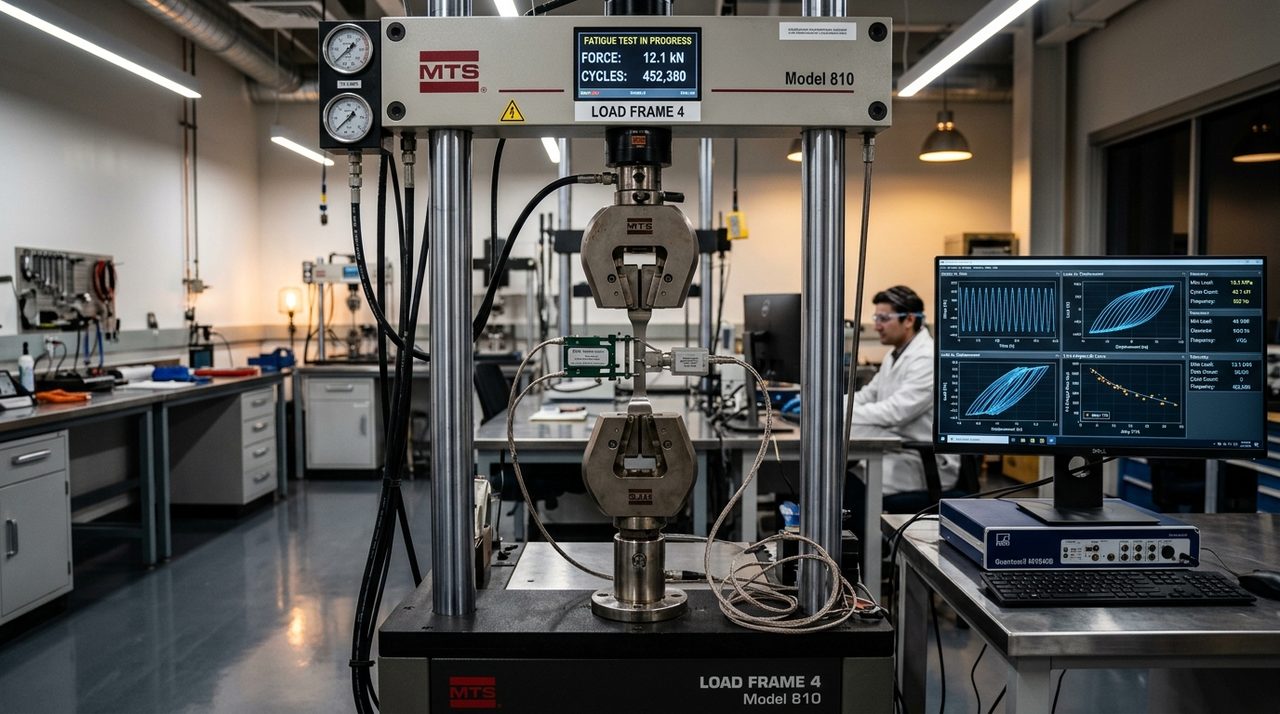
Whether engineering a hypersonic re-entry heat shield, an internal combustion engine piston, an ultra-dense semiconductor CPU heat sink, or an energy-storage molten salt tank, materials are governed by fundamental thermal properties. A material’s response to thermal energy dictates its heat transport rate, dimensional stability across temperature swings, and structural resistance to thermal stress cracking. In severe environments, thermal failure occurs not by exceeding melting points, but via thermal expansion mismatches, localized thermal shocking, and low-cycle thermal fatigue.
This comprehensive technical analysis explores the solid-state physics and engineering thermodynamics governing material thermal behavior. It details thermal conductivity via free electron vs. lattice phonon transport mechanisms, analyzes thermal diffusivity ((\alpha)) and laser flash analysis (LFA), evaluates thermal expansion dilatometry and the anharmonic interatomic potential well, investigates thermal shock and thermal fatigue damage criteria, and provides quantitative thermal property data across structural metals, technical ceramics, polymers, and composites.
1. Solid-State Physics of Thermal Conduction: Electrons vs. Phonons
Thermal conduction is the transfer of internal kinetic energy across a temperature gradient ((\nabla T)), governed macroscopically by Fourier’s Law: (q = -k \nabla T), where (q) is heat flux ((\text{W/m}^2)) and (k) is Thermal Conductivity ((\text{W/m}\cdot\text{K})). At the atomic scale, heat is transported through solid matter via two distinct energy carriers:
k = k_e + k_{ph}
Where (k_e) is thermal conduction by free electrons and (k_{ph}) is thermal conduction by quantized crystal lattice vibrational waves, termed phonons.
1.1 Free Electron Conduction in Metals: The Wiedemann-Franz Law
In electrical conductors (such as copper, aluminum, silver, and gold), thermal conduction is overwhelmingly dominated by the movement of free conduction-band electrons ((k_e \gg k_{ph})). Because the identical population of free electrons transports both electrical charge and thermal kinetic energy, an intimate fundamental relationship exists between thermal conductivity ((k)) and electrical conductivity ((\sigma)), formulated as the Wiedemann-Franz Law:
\frac{k}{\sigma T} = L = \frac{\pi^2 k_B^2}{3 e^2} \approx 2.44 \times 10^{-8} \text{ W}\cdot\Omega\cdot\text{K}^{-2}
Where (L) is the universal Lorenz Number, (k_B) is the Boltzmann constant, and (e) is electron charge. This relationship demonstrates why metals with superior electrical conductivity (e.g., pure copper, (k \approx 400 \text{ W/m}\cdot\text{K})) are naturally superior thermal conductors. However, alloying metals with solute atoms (e.g., adding zinc to copper to form brass) introduces atomic mass defects that scatter electrons, drastically dropping thermal conductivity (brass drops to (k \approx 115 \text{ W/m}\cdot\text{K})).
1.2 Phonon Lattice Conduction in Dielectrics and Diamond
In electrical insulators (ceramics, glasses, polymers), free conduction electrons are absent ((k_e = 0)). Heat must be transported exclusively via phonons—quantized collective vibrational waves propagating through the elastic atomic lattice. Phonon thermal conductivity is modeled via kinetic theory:
k_{ph} = \frac{1}{3} C_v \cdot v \cdot l
Where (C_v) is volumetric heat capacity, (v) is the mean acoustic sound velocity within the crystal, and (l) is the phonon mean free path. At room temperature, (l) is limited by Umklapp Scattering (phonon-phonon collisions that disrupt crystal momentum) and scattering at grain boundaries, impurities, and crystal defects:
- Diamond and Cubic Boron Nitride (c-BN): Represent the ultimate thermal conductors known to physics. Diamond exhibits an astronomical room-temperature thermal conductivity exceeding 2,000 W/m·K—five times higher than pure copper! This exceptional conduction occurs because diamond consists of ultra-light carbon atoms bound by rigid (sp^3) covalent bonds, resulting in an extreme Debye temperature ((\theta_D \approx 2220 \text{ K})), high acoustic sound velocity ((v \approx 18,000 \text{ m/s})), and a long phonon mean free path.
- Amorphous Glasses and Polymers: Possess a disordered, non-crystalline atomic structure lacking long-range order. The phonon mean free path is restricted to interatomic distances ((l \approx 0.5–1.0 \text{ nm})), resulting in ultra-low thermal conductivities ((k \approx 0.15–1.4 \text{ W/m}\cdot\text{K})) that make them natural thermal insulators.
2. Thermal Diffusivity ((\alpha)) and the Laser Flash Method
While thermal conductivity ((k)) measures heat transport under steady-state conditions, transient heating and cooling (unsteady-state heat transfer) are governed by Thermal Diffusivity ((\alpha)), which measures the rate at which thermal disturbances diffuse through a material:
\alpha = \frac{k}{\rho \cdot C_p}
Where (\alpha) is measured in (\text{m}^2/\text{s}) (or (\text{mm}^2/\text{s})), (\rho) is density ((\text{kg/m}^3)), and (C_p) is specific heat capacity ((\text{J/kg}\cdot\text{K})). High thermal diffusivity indicates that heat rapidly equilibrates throughout the material bulk, preventing localized thermal stress concentrations.
The Laser Flash Analysis (LFA) Technique (ASTM E1461)
The global benchmark for measuring thermal diffusivity across temperatures from -100°C to +2800°C is Laser Flash Analysis (LFA):
- A small, thin disc-shaped specimen (typically 10 to 12 mm diameter, 1 to 2 mm thickness) is held inside an isothermal furnace under vacuum or inert gas.
- A high-energy laser pulse (or xenon flash lamp) deposits an instantaneous, uniform pulse of radiant thermal energy onto the specimen’s front face.
- Heat diffuses through the specimen thickness ((L)). A high-speed liquid-nitrogen-cooled Indium Antimonide (InSb) or Mercury Cadmium Telluride (MCT) infrared detector monitors the resulting temperature rise on the rear face.
- Thermal diffusivity is calculated from Parker’s classical formula using the half-rise time ((t_{1/2}), the time required for the rear face to reach 50% of its maximum temperature rise):
\alpha = 0.1388 \cdot \frac{L^2}{t_{1/2}}
3. Thermal Expansion Dilatometry and Interatomic Potential Asymmetry
Nearly all materials expand when heated and contract when cooled. The linear dimensional change is governed by the Linear Coefficient of Thermal Expansion (CTE, (\alpha_L)) (standardized by ASTM E228 via push-rod dilatometry):
\alpha_L = \frac{1}{L_0} \left( \frac{\partial L}{\partial T} \right)_P \implies \Delta L = \alpha_L \cdot L_0 \cdot \Delta T
Quantum Origin: The Anharmonic Potential Well
Thermal expansion does not arise simply from increased atomic vibration amplitude. If the interatomic potential energy well were purely harmonic (a symmetric parabola (U(r) = \frac{1}{2} k (r – r_0)^2)), increasing thermal energy would cause atoms to vibrate symmetrically about their equilibrium interatomic separation ((r_0)), resulting in zero net volume change!
Thermal expansion occurs because real interatomic potential wells (such as the Lennard-Jones potential) are anharmonic (asymmetric):
- The repulsive force curve (when electron clouds overlap at (r < r_0)) is extremely steep.
- The attractive force curve (at (r > r_0)) slopes gently.
- As temperature rises, thermal energy causes the mean interatomic separation ((\bar{r})) to shift progressively toward larger distances, producing macroscopic expansion.
- Materials with deep, steep potential energy wells (e.g., diamond, tungsten, SiC) have high melting points, high elastic moduli, and ultra-low coefficients of thermal expansion ((\alpha_L < 5 \times 10^{-6} \text{ K}^{-1})). Weakly bonded materials (e.g., polyethylene, rubber) have shallow potential wells and huge CTEs ((\alpha_L > 100 \times 10^{-6} \text{ K}^{-1})).
Near-Zero Expansion Alloys: Invar (Fe-36Ni)
In 1896, Charles Édouard Guillaume discovered that an iron-nickel alloy containing 36 wt% Nickel—termed Invar 36—exhibits a near-zero CTE ((\alpha_L \approx 1.2 \times 10^{-6} \text{ K}^{-1})) around room temperature. This remarkable phenomenon, known as the Invar Effect, arises from magnetostrictive volume expansion: as temperature increases toward Invar’s Curie point, spontaneous thermal expansion is cancelled out by an internal contraction of the electron spin band structure, maintaining constant dimensions for precision clock pendulums, laser cavity mounts, and satellite optical benches.
4. Quantitative Thermal Properties Data Matrix Across Material Classes
The following engineering data table compares the foundational thermal parameters across prominent structural metals, ceramics, polymers, and carbon structures at 20°C:
| Material Designation | Thermal Conductivity ((k), W/m·K) | Specific Heat ((C_p), J/kg·K) | Density ((\rho), g/cm³) | Thermal Diffusivity ((\alpha), mm²/s) | Linear CTE ((\alpha_L, 10^{-6} \text{ K}^{-1})) | Primary Engineering Role |
|---|---|---|---|---|---|---|
| Pure Copper (C10100 OFHC) | 398 | 385 | 8.94 | 115.6 | 16.8 | Heat exchangers, microelectronics cooling baseplates |
| Aluminum 6061-T6 | 167 | 896 | 2.70 | 69.0 | 23.4 | Extruded automotive radiators, electronics enclosures |
| Invar 36 (Fe-36Ni) | 10.5 | 515 | 8.05 | 2.5 | 1.2 | CFRP layup tooling, satellite optical benches |
| CVD Silicon Carbide (SiC) | 270 | 670 | 3.21 | 125.5 | 4.3 | Semiconductor wafer chucks, space telescope mirrors |
| 8YSZ Thermal Barrier Coating | 1.8 | 580 | 5.85 | 0.53 | 10.5 | Jet engine turbine blade thermal insulation |
| Natural Diamond (Type IIa) | 2,200 | 516 | 3.52 | 1,211.0 | 1.1 | High-power laser diode mounts, synchrotron windows |
| PEEK Polymer (Unfilled) | 0.25 | 1,340 | 1.30 | 0.14 | 47.0 | Thermal isolator bushings, chemical valve seats |
5. Thermal Stress, Thermal Shock, and Thermal Fatigue Mechanics
When a solid material experiences a temperature change ((\Delta T)) but is physically constrained from freely expanding or contracting, intense internal thermal stresses are generated. For a fully constrained homogeneous rod:
\sigma_{th} = -E \cdot \alpha_L \cdot \Delta T
Where (E) is Young’s modulus. If a hot component is rapidly quenched with cold water ((\Delta T < 0)), the exterior surface contracts while the hot interior remains expanded. This generates intense biaxial tensile stresses on the exterior surface. If this tensile stress exceeds the fracture strength ((\sigma_{th} \ge \sigma_f)), catastrophic surface cracking occurs—a phenomenon known as thermal shock.
Thermomechanical Fatigue (TMF)
In power generation turbines and automotive exhaust manifolds, components experience simultaneous cyclic mechanical strain and cyclic thermal swings—termed Thermomechanical Fatigue (TMF):
- In-Phase (IP) TMF: Maximum tensile mechanical stress coincides with maximum peak temperature. Dominated by high-temperature creep cavity growth, grain boundary sliding, and rapid intergranular oxidation.
- Out-of-Phase (OP) TMF: Maximum tensile mechanical stress occurs at minimum temperature, while peak compression occurs at peak temperature. Repeated compressive yielding at high temperatures generates large tensile residual stresses upon cooling, accelerating transgranular fatigue crack propagation.
6. Frequently Asked Questions (FAQ) Regarding Thermal Properties
Q1: What is the physical difference between thermal conductivity and thermal diffusivity?
Answer: Thermal conductivity ((k)) represents a material’s capability to transfer heat under steady-state conditions where temperature gradients are constant over time (measured in Watts per meter-Kelvin, W/m·K). Thermal diffusivity ((\alpha = \frac{k}{\rho C_p})) evaluates how fast a material adjusts its internal temperature in response to a changing, transient thermal boundary condition (measured in square millimeters per second, mm²/s). While two materials can have similar thermal conductivities, the material with lower volumetric heat capacity ((\rho C_p)) will exhibit a dramatically higher thermal diffusivity, equilibrating temperature swings much faster.
Q2: Why does diamond conduct heat better than copper, despite being an electrical insulator?
Answer: Copper conducts heat via free electrons, while diamond conducts heat via lattice vibrational waves called phonons. Diamond possesses the strongest covalent bonds ((sp^3) carbon bonds) and lowest atomic mass (carbon, atomic weight 12) of any solid, resulting in an exceptionally stiff crystal lattice. This stiffness gives diamond the highest acoustic sound velocity ((\sim 18,000 \text{ m/s})) and an exceptionally high Debye temperature (2220 K). At room temperature, Umklapp phonon-phonon scattering is suppressed, allowing phonons to travel through diamond with a long mean free path (> 100 nm) without scattering, resulting in a thermal conductivity exceeding 2,000 W/m·K (five times higher than copper).
Q3: What causes the Invar Effect in Fe-36Ni alloys?
Answer: In standard metals, thermal expansion is caused by the asymmetric (anharmonic) vibration of atoms expanding interatomic spacing as thermal energy increases. In Invar 36 (64% iron, 36% nickel), an opposing quantum-mechanical phenomenon occurs: the alloy is ferromagnetic below its Curie temperature (280°C). As temperature rises, thermal energy progressively disrupts electron spin alignments, causing electrons to transition from a high-volume ferromagnetic state to a low-volume antiferromagnetic/paramagnetic configuration. This internal magnetostrictive volume contraction precisely cancels out the normal anharmonic lattice expansion, resulting in zero net dimensional change between -20°C and +100°C.
Q4: Why are ceramic Thermal Barrier Coatings (TBC) engineered with high porosity?
Answer: In gas turbine blades, the ceramic top coat (yttria-stabilized zirconia, YSZ) is deliberately applied via atmospheric plasma spray (APS) with 10% to 15% open micro-porosity and inter-splat microcracks. This porosity serves two critical thermal functions: First, stationary air or gas trapped within the microscopic pores has a thermal conductivity near zero ((k_{gas} \approx 0.03 \text{ W/m}\cdot\text{K})), reducing the effective bulk thermal conductivity of the coating by over 40% (down to 1.2 to 1.5 W/m·K). Second, the microcrack network reduces the in-plane elastic modulus, providing strain tolerance that allows the brittle ceramic to expand and contract with the underlying superalloy blade without spalling.
Q5: What is the significance of the Pyrometric Cone Equivalent (PCE)?
Answer: The Pyrometric Cone Equivalent (standardized under ASTM C24) is an empirical industrial test utilized to determine the refractoriness and softening behavior of ceramic and refractory materials under heating. Standardized slender trihedral cones made from the test material are heated alongside calibrated standard reference cones inside a furnace at a controlled heating rate (typically 2.5°C to 15°C/min). The PCE rating corresponds to the number of the standard reference cone whose tip bends over and touches the plaque at the exact same moment the test cone softens, providing a definitive index of high-temperature load resistance.
7. Engineering Summary and Thermal Management Design Protocols
Engineering materials for thermal environments requires balancing steady-state heat conduction against transient thermal stress tolerance. Successful thermal design demands a multi-parameter approach: maximizing thermal diffusivity in heat sinks via copper-diamond or pure aluminum, tailoring low thermal expansion in precision structures using Invar or silicon carbide, and engineering strain-tolerant porous microstructures to survive extreme thermomechanical fatigue in aerospace propulsion.
By understanding electron and phonon transport physics, dilatometric expansion kinetics, and transient heat transfer thermodynamics, materials scientists design robust components capable of operating across temperature extremes from deep cryogenic space to raging gas turbine combustors.