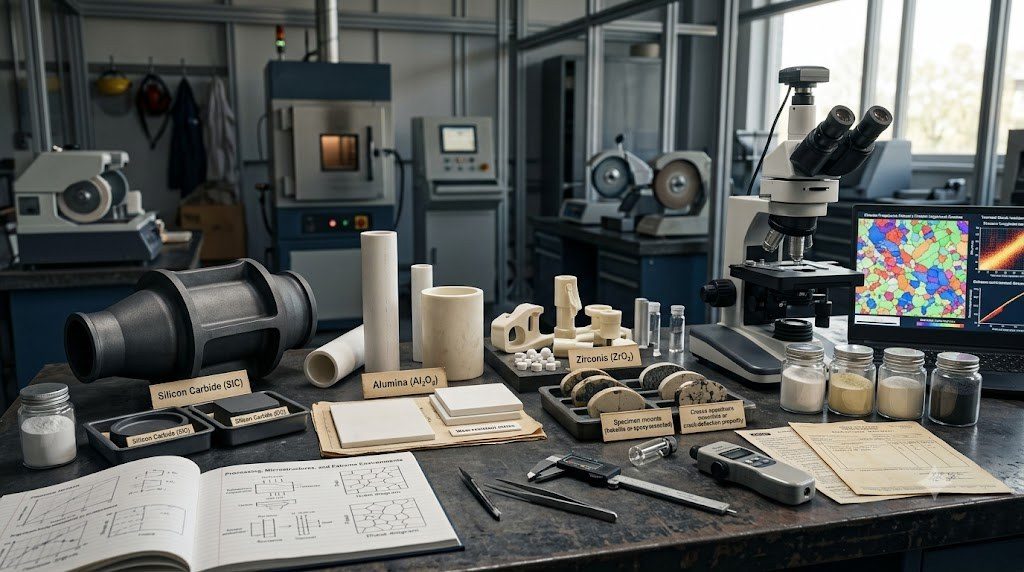
When engineering components must operate at temperatures beyond the melting point of superalloys, withstand intense mechanical abrasion that rapidly erodes hardened tool steels, or survive concentrated chemical attacks in corrosive processing lines, structural metals inevitably fail. In these hostile environments, advanced technical ceramics take precedence. Unlike traditional silicate ceramics (clay, bricks, and porcelain), advanced structural ceramics are engineered from ultra-pure, non-silicate inorganic compounds featuring dominant ionic and covalent atomic bonds.
This technical treatise provides an in-depth analysis of the primary structural ceramics—Alumina (\(\text{Al}_2\text{O}_3\)), Zirconia (\(\text{ZrO}_2\)), and Silicon Carbide (\(\text{SiC}\)). We examine their underlying atomic structures, analyze the phenomenon of transformation toughening in yttria-stabilized zirconia (YSZ), evaluate mechanical and thermal shock resistance parameters, detail ceramic powder synthesis and sintering kinetics, and showcase real-world industrial deployments in ballistic armor, wear components, and high-temperature thermal barriers.
1. The Atomic Nature and Fundamental Physics of Technical Ceramics
The distinctive properties of technical ceramics—extreme compressive strength, exceptional hardness, chemical inertness, high melting points, and electrical insulation—arise directly from the nature of their atomic bonds. Ionic bonds (where valence electrons are transferred between electropositive metals and electronegative non-metals) and covalent bonds (where outer orbital electron pairs are shared symmetrically) possess extraordinarily high dissociation energies, often exceeding 500 to 1000 kJ/mol.
The Peierls Stress and Intrinsic Brittleness
While metallic bonding features a delocalized “sea of electrons” that permits crystal planes to slide easily without severing localized atomic ties (conferring malleability and ductility), ceramic crystals require dislocations to overcome an immense lattice friction known as the Peierls-Nabarro stress. In ionic ceramics, like-charged ions cannot be brought into adjacent alignment during shear without generating violent electrostatic repulsion, triggering catastrophic cleavage. In covalent ceramics, highly directional covalent bonds must be simultaneously broken. Consequently, structural ceramics exhibit virtually zero room-temperature plastic deformation; when local tensile stresses at a micro-flaw reach theoretical bond strength, the ceramic fractures catastrophically via brittle cleavage.
Griffith Fracture Mechanics in Brittle Solids
The fracture strength of technical ceramics is governed by the classic Griffith Criterion for brittle fracture, which relates fracture stress (\(\sigma_f\)) to critical crack size (\(a\)), Young’s modulus (\(E\)), and surface fracture energy (\(\gamma_s\)):
Where \(K_{Ic}\) represents the Plane-Strain Fracture Toughness, and \(Y\) is a dimensionless geometry factor. Because technical ceramics naturally contain processing microflaws (e.g., residual sinter pores, microcracks, grain boundary inclusions) typically 10 to 50 \(\mu\text{m}\) in length, and standard fracture toughness is low (3 to 5 \(\text{MPa}\cdot\sqrt{\text{m}}\)), their tensile strength is typically one-tenth of their compressive strength. Overcoming this intrinsic brittleness represents the central focus of modern ceramic engineering.
2. Primary Structural Ceramic Materials Profiled
1. Alumina (Aluminum Oxide, \(\alpha\text{-Al}_2\text{O}_3\))
Alumina is the most mature, cost-effective, and widely utilized technical ceramic in global industry. High-purity technical alumina grades (96% to 99.9% \(\text{Al}_2\text{O}_3\)) crystallize in the trigonal/hexagonal corundum structure, where close-packed oxygen ions form an octahedral network with aluminum ions occupying two-thirds of the interstitial sites.
Alumina features exceptional chemical inertness against aggressive acids and molten salts, extreme wear resistance (Vickers Hardness ~1500–1800 HV), an elastic modulus exceeding 380 GPa, and outstanding dielectric strength, making it ideal for electrical insulators, ceramic pump plungers, sandblast nozzles, and wear-resistant tile linings for mining chutes.
2. Transformation-Toughened Zirconia (TTZ / 3Y-TZP)
Pure Zirconia (\(\text{ZrO}_2\)) undergoes three temperature-dependent crystallographic polymorphs: monoclinic from room temperature to 1170°C, tetragonal from 1170°C to 2370°C, and cubic up to its melting point of 2715°C. The tetragonal-to-monoclinic (\(t \rightarrow m\)) phase change upon cooling involves a disruptive 3% to 5% volume expansion and high shear strain, causing unalloyed zirconia to shatter upon cooling from sintering temperatures.
However, by doping zirconia with stabilizing rare-earth oxides—most notably 3 mol% Yttria (\(\text{Y}_2\text{O}_3\)) to produce 3Y-TZP (Tetragonal Zirconia Polycrystal)—the high-temperature tetragonal phase can be metastably retained at room temperature in sub-micron grains. This enables Transformation Toughening, conferring fracture toughness values exceeding 8 to 12 \(\text{MPa}\cdot\sqrt{\text{m}}\), earning zirconia the title of “ceramic steel.”
3. Silicon Carbide (SiC): Sintered (SSiC) and Reaction-Bonded (RBSC)
Silicon Carbide is a covalently bonded ceramic characterized by high thermal conductivity (exceeding 120 W/m·K, rivaling metals), extreme hardness (2500–2800 HV, second only to diamond and boron carbide), and superior thermal shock resistance. Sintered Alpha SiC (SSiC) maintains mechanical strength at temperatures above 1400°C without significant creep or oxidation, serving as the material of choice for mechanical seal faces in chemical pumps, heat exchanger tubes, and astronomical telescope mirror blanks.
3. Material Property Comparison Matrix
The following engineering data table contrasts the fundamental physical, mechanical, and thermal properties of leading structural ceramics:
| Property Parameter | Alumina (99.5% Al₂O₃) | Zirconia (3Y-TZP) | Silicon Carbide (SSiC) | Silicon Nitride (Si₃N₄) |
|---|---|---|---|---|
| Density (g/cm³) | 3.92 | 6.05 | 3.15 | 3.20 |
| Flexural Strength (4-point, MPa) | 380 | 1000 – 1200 | 450 | 850 |
| Fracture Toughness (MPa·√m) | 3.8 | 8.0 – 10.0 | 3.5 – 4.0 | 6.5 – 7.5 |
| Vickers Hardness (HV 10, GPa) | 16.5 | 12.5 | 26.0 | 15.0 |
| Thermal Conductivity (W/m·K) | 30 | 2.0 – 2.5 | 120 – 140 | 30 |
| Max Use Temperature in Air (°C) | 1650 | 950 | 1500 | 1200 |
4. Transformation Toughening in Zirconia: How “Ceramic Steel” Works
The transformation toughening mechanism in 3Y-TZP is one of the landmark achievements of modern materials science. In unstressed 3Y-TZP, the tetragonal grains are constrained in a metastable state by the surrounding matrix. When a tensile stress concentration develops at a propagating crack tip, the localized stress tensor relieves the constraining matrix pressure.
This triggers the instantaneous martensitic transformation of tetragonal grains into the monoclinic phase right at the crack tip. Because the monoclinic lattice occupies 3% to 5% greater volume, this expansion exerts intense compressive clamping stresses on the crack wake, actively shielding the crack tip from further opening and blunting crack propagation.
5. Thermal Shock Resistance and Kingery Parameter
Ceramics are susceptible to thermal shock failure—catastrophic fracture induced by steep thermal gradients during rapid heating or cooling. The thermal shock resistance parameter (\(R\)) formulated by W.D. Kingery governs maximum permissible temperature differentials (\(\Delta T_c\)):
Where \(\sigma_f\) is flexural strength, \(\nu\) is Poisson’s ratio, \(k\) is thermal conductivity, \(E\) is Young’s modulus, and \(\alpha\) is the linear coefficient of thermal expansion (CTE). Materials combining high thermal conductivity, high strength, and low thermal expansion (such as Silicon Carbide and Silicon Nitride) provide superior thermal shock survivability compared to low-conductivity alumina and zirconia.
6. Frequently Asked Questions (FAQ)
Why does zirconia suffer from Low-Temperature Degradation (LTD)?
In the presence of moisture or steam at temperatures between 60°C and 250°C, yttria-stabilized zirconia undergoes Low-Temperature Degradation (aging). Water molecules dissociate and diffuse into oxygen vacancies within the zirconia lattice, triggering spontaneous tetragonal-to-monoclinic transformation on the component surface without applied stress. This induces surface microcracking, roughness, and eventual loss of strength. Modern medical-grade zirconia incorporates alumina dopants to completely suppress LTD.
How are technical ceramics formed and sintered?
Ceramics cannot be melted and cast like metals due to their high melting points. Instead, sub-micron ceramic powders are mixed with organic binders and consolidated into “green bodies” via dry pressing, cold isostatic pressing (CIP), slip casting, or injection molding. The green component is then heated in a sintering furnace at 1400°C–2000°C, where solid-state atomic diffusion drives pore elimination and grain coalescence, shrinking the part by 15% to 25% to achieve near-theoretical density.
7. Conclusion
Advanced structural ceramics have outgrown their historical role as passive electrical insulators to become critical structural materials in the most demanding engineering applications. From transformation-toughened zirconia hip prosthetics and silicon carbide mechanical seals to alumina ballistic body armor, their unique atomic structures provide hardness, wear resistance, and thermal capability beyond the limits of structural metals.
8. Weibull Modulus and Statistical Fracture Mechanics in Structural Ceramics
Unlike ductile metals that yield plastically to relieve local stress concentrations around internal voids or inclusions, advanced structural ceramics are completely brittle at ambient and moderate operating temperatures. Tensile failure in ceramics is governed strictly by the Griffith Fracture Criterion, where the critical fracture stress ((\sigma_f)) is linked to the critical fracture toughness ((K_{Ic})) and the size of the most severe microstructural defect ((a)):
(\sigma_f = \frac{K_{Ic}}{Y \sqrt{\pi a}})
Here, (Y) is a dimensionless geometric factor depending on defect shape and location. Because internal processing defects (such as sintering pores, agglomerate voids, and microcracks) follow a random spatial and size distribution, identical ceramic test specimens tested under identical loading conditions exhibit a broad scatter in measured tensile strengths. Consequently, structural ceramic components cannot be engineered using simple deterministic safety factors; they require Weibull Statistical Analysis.
Weibull Cumulative Failure Probability Distribution
The two-parameter Weibull distribution expresses the cumulative probability of failure ((P_f)) of a ceramic specimen subjected to an applied tensile stress ((\sigma)) across an effective volume ((V)):
(P_f = 1 – \exp\left[ -\int_V \left( \frac{\sigma}{\sigma_0} \right)^m dV \right])
Where (\sigma_0) is the characteristic strength (the stress at which 63.2% of specimens fail for unit volume) and (m) is the Weibull Modulus. The Weibull modulus serves as the definitive engineering index of microstructural homogeneity and material reliability:
- Traditional Ceramics (Bricks, Clay, Monolithic Refractories): Typically feature low Weibull moduli ((m = 3 \text{ to } 7)), reflecting wide variability and poor predictability under mechanical loads.
- Engineering Ceramics (Standard Sintered Alumina, Reaction-Bonded SiC): Exhibit intermediate moduli ((m = 8 \text{ to } 14)).
- Advanced Structural Ceramics (Hot Isostatically Pressed Y-TZP, Gas-Pressure Sintered Si3N4): Achieve high Weibull moduli ((m = 18 \text{ to } 25+)), approaching the statistical reliability required for human-rated automotive turbocharger rotors, hip replacements, and semiconductor handling fixtures.
9. Advanced Ceramic Densification Technologies: SPS and HIP Processing
Achieving near-zero porosity without causing uncontrolled grain coarsening is the central objective in technical ceramic synthesis. Two cutting-edge consolidation technologies dominate modern industrial manufacturing:
| Consolidation Technology | Operating Principle & Parameters | Microstructural Impact | Primary Engineering Applications |
|---|---|---|---|
| Hot Isostatic Pressing (HIP) | Simultaneous application of high temperature (up to 2000°C) and isostatic gas pressure (100–200 MPa argon) in a high-pressure autoclave. | Collapses internal pores via plastic creep and grain boundary diffusion; reaches > 99.9% theoretical density. | Dental zirconia blanks, silicon nitride bearing balls for jet engines, armor plates. |
| Spark Plasma Sintering (SPS / FAST) | Pulsed direct electric current (thousands of amps) passed through conductive graphite dies under uniaxially applied pressure (30–100 MPa). | Rapid heating rates (> 500°C/min); achieves full densification in minutes; completely suppresses grain growth; produces nanostructured ceramics. | Ultra-high temperature ceramics (UHTCs like ZrB2, HfC), transparent ceramics, solid-state electrolyte membranes. |
10. Ceramic Armor Systems: Ballistic Impact and Hugoniot Elastic Limit (HEL)
The extreme hardness and high compressive strength of structural ceramics make them irreplaceable in modern body armor and armored vehicle strike faces. When an armor-piercing projectile strikes a ceramic strike face at velocities between 800 and 1000 m/s, several sequential dynamic failure mechanisms occur:
- Projectile Dwell and Blunting: Upon instantaneous impact, the compressive stress exceeds the yield strength of the hardened steel or tungsten carbide penetrator core while remaining below the ceramic’s Hugoniot Elastic Limit (HEL) (typically 12 to 16 GPa for SiC, 15 to 20 GPa for B4C). The projectile nose mushrooms and shatters without immediately penetrating the ceramic surface.
- Hertzian Cone Crack Propagation: Compressive shock waves propagate through the ceramic tile, reflecting from the rear surface as high-intensity tensile release waves. This induces a characteristic inverted conical network of fracture surfaces (Hertzian cone cracks) that pulverizes the ceramic into fine microscopic powder (“comminution” zone).
- Energy Absorption via Backing Laminate: The pulverized ceramic fragments and blunted projectile debris distribute the residual kinetic energy over a wide area onto a ductile fiber backing plate (composed of ultra-high-molecular-weight polyethylene UHMWPE or Kevlar aramid), capturing the threat without penetration.
11. Sialon Ceramics: Synthesis, Phase Relationships, and High-Speed Machining
Sialons are solid solutions of silicon nitride ((\text{Si}_3\text{N}_4)) where silicon is partially substituted by aluminum, and nitrogen is isomorphously substituted by oxygen ((\text{Si}_{6-z}\text{Al}_z\text{O}_z\text{N}_{8-z}), where (z) represents the substitution value between 0 and 4.2). Developed in the 1970s, Sialons bridge the high hardness and thermal shock resistance of silicon nitride with the high chemical stability and oxidation resistance of alumina.
There are two primary phases of engineering Sialons:
- (\alpha\)-Sialon: Characterized by an expanded hexagonal crystal lattice stabilized by interstitial cations (such as (\text{Y}^{3+}\), (\text{Yb}^{3+}\), or (\text{Nd}^{3+}\)). (\alpha\)-Sialons feature exceptional hardness (> 19 GPa) and extreme abrasion resistance.
- (\beta\)-Sialon: Possesses elongated, needle-like hexagonal prismatic grains that interlock during liquid-phase sintering, providing self-reinforcing crack deflection and exceptional fracture toughness ((K_{Ic} > 7.5 \text{ MPa}\cdot\sqrt{\text{m}})).
In aerospace manufacturing, dual-phase ((\alpha+\beta\)) Sialon ceramic cutting inserts enable the high-speed milling and turning of heat-resistant nickel-base superalloys (such as Inconel 718 and Waspaloy) at cutting speeds up to 1000 m/min—more than ten times the maximum cutting velocity permitted by conventional cemented tungsten carbide tools.